AI at work: from chat to agents
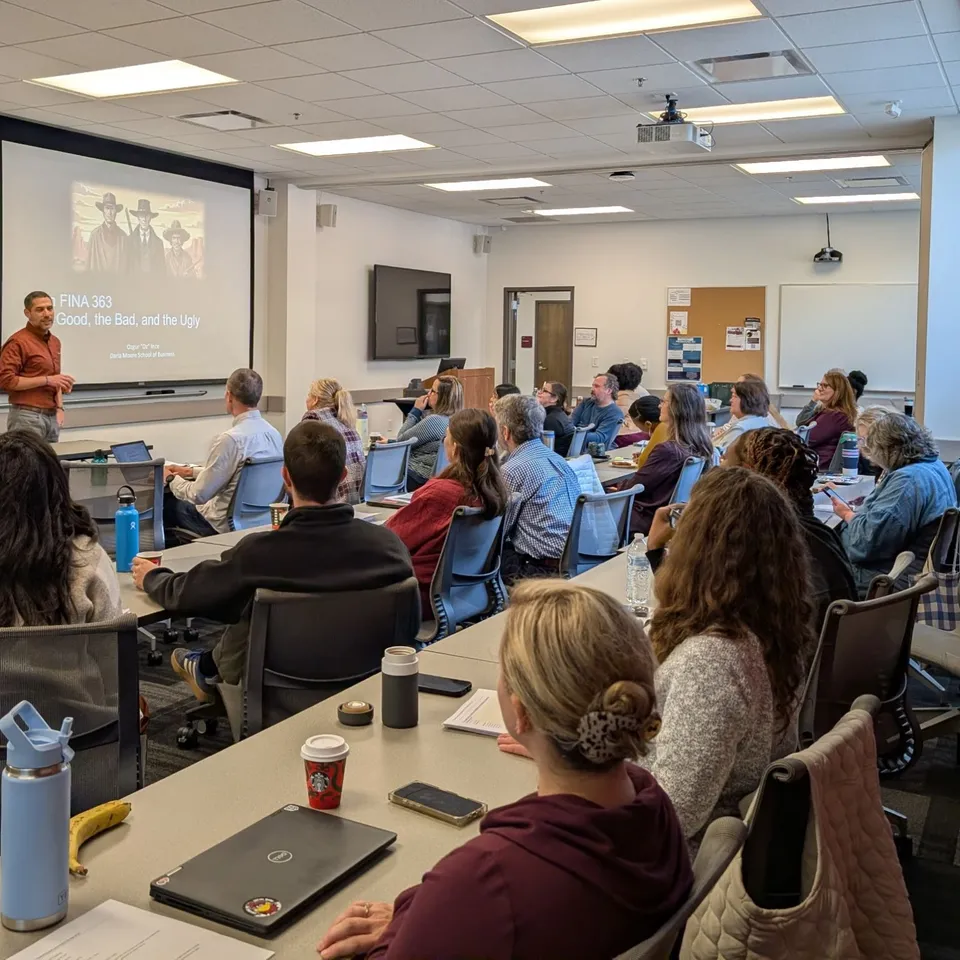
Most people have tried a chatbot. Far fewer have handed one a real piece of their work. This session walks from a single conversation to a project that knows the business, a repeatable process, and an agent that runs it on a schedule, all demonstrated live on the files of a fictional company.
- For
- Business teams, executives, and alumni groups
- Format
- One-hour talk with live demonstrations, or a half-day or full-day hands-on workshop
- A plain-language picture of how language models work and where they fail
- A short screen for choosing the first workflow worth automating
- Ways to protect sensitive information
- A habit of checking the output: agreement among AIs is not proof
Preparing students for an AI-enabled future
As AI gets more reliable, it gets easier for students to hand over the thinking itself. This session is about the educator’s balancing act: deciding, objective by objective, where AI belongs in learning and where it does not, and how assessment has to change in response.
- For
- Teachers and faculty, from K–12 to university
- Format
- Talk or workshop
- A way to sort each learning objective by the role AI should play in it
- Assessment that looks at process, explanation, and judgment, not only the finished product
- Examples of classroom tools built with AI, with the prompts that produced them
Building the AI-ready business school
What it takes to prepare every graduate, not only the technically inclined, for work that AI is changing. I describe how we think about AI readiness at the Moore School and what I have learned leading the effort.
- For
- Deans, university leaders, and advisory boards
- Format
- Talk or working session
- A working definition of an AI-ready graduate: AI fluency, knowledge of the field, judgment, and human skills
- The parts of a school that have to move together: curriculum, faculty, research, executive education, partnerships, and student experience
- Where to start
AI in finance and decision support
Where AI helps in financial reporting, analysis, and management decisions, and where a finance professional still has to do the checking. Built around worked examples, including a financial-statement reconciliation in which AI found accounts that had been left out of the totals.
- For
- Chief financial officers and finance teams
- Format
- Talk or workshop
- Tasks in a finance function that suit delegation, collaboration, or human-led work
- Why to reconcile before you automate
- A way to test AI output against the standard a human reviewer would apply
AI in a specific workflow or sector
The same ideas applied to one field. For a conference of government contractors, for example, I traced four workflows across the procurement cycle: finding opportunities, understanding a solicitation, preparing to win, and managing the contract.
- For
- Industry and professional groups
- Format
- Conference session or workshop, prepared for the audience
- Demonstrations on documents and tasks the audience recognizes
- A prompt guide to take back to work
- One workflow to start with